Remaung6renjer

Nuffnang

Saturday, July 23, 2011

The Myth of Formation of Malaysia : Our Forefathers Worry That Comes True

Kuching
Saturday, 23rd July 2011

One of the point that worry  Sabahans and Sarawakians before they had decided to be part  of Malaysia was the Malay or Muslim dominant in these two Christian majority states. And after 48 years with the Federation, the native of Sabahan and Sarawak now start to realise that their forefathers worry has become a reality. The only reason why the leaders from these two states do not talk about pulling out from the Federation because they afraid of losing their ministership.

Unequal Merger
Should the leaders from these two states decided to pull out from the federation, Malay dominant should not be the only reason. Apart from Malay dominant the unfairly distribution of wealth and development between the states in peninsular and Sabah and Sarawak could be also use. After 48 years with the federation not much development have been felt by Sabahans and Sarawakians. If  prior to  year 1963 no electricity, roads and clean water had reached most of the native, now the same situation is still felt by the natives. To all Sabahan and Sarawakians, please do not fool by Najib 1Malaysia "Performance Now People First" slogan as it is only meant to fish for their votes.

For the benefits of the new generation, today Bukittunggal would like to share an article on the formation of Malaysia which is also includes our forefather main worry,  the Malay Dominant.

INDEPENDENCE OF MALAYA AND THE FORMATION OF MALAYSIA.

Racial Problems 

Malaya consists of a ‘"plural society" which was formed by different races with various backgrounds and customs. In The Malaysian Development Experience, Changes and Challenges book that published by INTAN, states that Malaya is "a colonial creation with ethnic groups living side by side but never mixed". Many factors have caused this situation. The first can be traced back to the "divide and rule" policy during British colonization. This kind of administration greatly limited interaction and communication among the different ethnic groups and segregated them according to their economic functions. The Malays were known to be farmers and fishermen and lived in the rural areas or kampung. Since there were also Malays who were involved in the government sector as ordinary officers and clerks, they were perceived to be dominant in politics and the first group of people that the British negotiated with.
Most of the Chinese were involved in the commercial and mining sectors and were found mainly in urban areas. The Indians, on the other hand, worked as labourers in estates and plantations. Hence, these two races were perceived to be more dominant in the economics of the country. The education system, as it was long before we know it today, also varied according to the different ethnic groups in terms of syllabus, curriculum and methods of dissemination. There was no such thing as a standardized education system back then.
While the Malays and Indians felt that a minimal amount of literacy was sufficient, the Chinese were vying to strengthen their bond with China through education, since most of the teachers and textbooks were imported from China. The same concept was practiced in Tamil schools.

Since these vernacular schools comprised a single race, lessons were conducted in its respective language, such as Malay, Mandarin and Tamil. Due to the inconsistencies and differences in the education system, there existed barriers and gaps among the different races in Malaya. The Japanese occupation only widened the rift between the races, especially the Chinese and Malays. While the Malays were given better treatment by the Japanese who were in need of their support, the Chinese were tortured and brutally mistreated. This led to the formation of the Malayan Peoples’ Anti-Japanese Army (MPAJA) to fight the Japanese. To ward off attacks from resistance groups which comprised mainly Chinese, the Japanese instigated the anti-Chinese feeling by forming paramilitary units which consisted mainly of Malays, and thus, further widened the gap among the two races. When the Communists began their violence in the 1948, the British were forced to declare a state of Emergency throughout Malaya. It was during this period that interracial relations became worse since the British had formed forces, comprising mostly Malays, to fight the guerilla groups led by the Communists, who were mainly Chinese. All of these factors caused a great division in the Malayan society and much effort had to be taken to resolve the problem.

Efforts Towards Racial Unity

In 1949, the Inter-Racial Relations Committee (Jawatankuasa Hubungan Antara Kaum) was formed, to enable leaders of various ethnic groups to find a solution to the existing racial problems. The committee, comprising Dato’ Onn bin Jaafar, Tan Cheng Lock, E.E.C Thuraisingham and 12 other members proposed that non-Malays be involved in local politics and more opportunities be given to the Malays in the business and industrial sectors. The committee also proposed that greater racial tolerance and understanding be fostered in the hope of achieving racial unity.
In 1951, the British government formed the Member System, with the hope of achieving racial unity. The member system was similar to the Cabinet system as we know it today, and enabled people from various ethnic groups to get involved in the administration of the government and hold portfolios in areas such as Home Affairs, Agriculture, Land, Mines and Communication, Education, Health, Forestry, and Works and Housing. Although the more important portfolios in areas of finance and defense were still dominated by the British, the involvement of leaders of various ethnic groups enabled co- operation among the different races. Education also played an important role in paving the way towards racial unity in Malaya.
In 1949, the Central Advisory Committee took form with the main purpose of unifying the local education system and implementing it. However, the committee failed to achieve its goal and its proposal that English be made the sole medium of education in schools in the Holgate Report was vehemently opposed by the Federal Legislative Council. Although the committee did not achieve much, it was a clear indication that the British were indeed making an effort to unify the multiracial society through education with one medium of instruction. Another committee which was established one year later, produced the Barnes Report, which recommended in 1952, that the syllabus of all primary schools be standardized and taught in English and Malay, while secondary schools retain English as their mode of instruction.
Led by Dr W.P.Fenn and Dr Y.T. Wu, the British formed yet another committee to study the status of Chinese vernacular education in Malaya to incorporate it into a unified education system. The result was the Fenn-Wu report, which agreed to a national education system, but at the same time, proposed that Chinese medium schools be maintained.
Finally, in 1952, the Education Ordinance based on the Barnes Report was approved. The Chinese and Indians were not in the least bit happy and resisted the new ruling. However, the long-awaited decision on the national education system was only seen in the Razak Report after much deliberation and ethnic bargaining. The report was subsequently approved by the Federal Legislative Council on 16th May, 1956.

Political Parties In Malaysia

United Malays National Organization (UMNO)

UMNO was formed on 11th May 1946 and led by its first President, Dato’ Onn bin Jaafar. Its sole purposes were, at that time, to unite the Malays and lead the opposition against the Malayan Union, to protect the interests of the Malays and to gain independence from the British. Several years later, a conflict of interest occurred between Dato’ Onn and his party members. In his belief that an inter-racial nation was essential to achieve proper independence, Dato’ Onn had proposed that non-Malays be allowed to join the party. Due to this conflict, Dato’ Onn resigned and was replaced by Tunku Abdul Rahman, who later became the first Prime Minister of Malaya.

Malayan Chinese Association (MCA)

 MCA was formed by Leong Yew Koh and Lee Hau-Shik on 27th Feb. 1949. Its first president was Tan Cheng Lock. The objectives of MCA were to unite the Chinese and protect their interests, to propose more liberal citizenship, and to co-operate with the government and oppose Communism during the Emergency years. The party received much respect from the rest of society due to their efforts against communism, which involved the recruitment of the Chinese into the police and armed forces, and the resettlement of the local community into "new villages".

Malayan Indian Congress (MIC)

MIC was formed in August 1946 by John Thivy, who sought to protect the rights of the Indian community in Malaya and voice their opinions to the government. In the earlier years of its formation, however, the party did not receive much support from local Indians since it was dominated by Indians from the upper class, while most of the Indians in Malaya at that time, were labourers who hailed from the lower class of society.
The MIC received full support from the Indian people of Malaya only when the Tamils took over the party in 1954.

The Fight For Independece

The elections In 1952, UMNO and MCA combined forces, formed the UMNO-MCA Alliance, and took part in the local government and town council elections. The results were overwhelming. They had won 9 out of the 12 seats contested. Realizing their potential as a joint coalition, both parties decided to take their efforts a step further – the general elections in 1955. This time, the MIC joined forces as well, and together the Alliance became a representative of the three main ethnic groups in Malaya. Another major victory was won in the 1955 elections when the Alliance bagged 51 out of the 52 seats contested. Tunku Abdul Rahman was elected the first Chief Minister, while 10 members from the Alliance were elected ministers. The majority of the Legislative Council was Alliance’s members, but the Executive Council was still dominated by British officials. Simultaneously, the High Commissioner held ultimate authority over any bill. As it was, Malaya still hadn’t been granted full independence. Tunku Abdul Rahman wasted no time and flew to London on his "Merdeka Mission" in January 1955 to coax the British to grant independence to Malaya. The British agreed and subsequently fixed the date for independence - 31st August 1957.

The Reid Commission

Before independence could be attained however, some details needed to be taken care of, the most important being a new constitution for an independent Malaya. Hence, the British government appointed Lord Reid to head the Commonwealth Constitutional Commission to chart a new constitution for Malaya. Known as the Reid Commission, the committee was given the task of preparing a constitution that would serve a united and democratic Malaya with a firm government foundation, bearing in mind that the Sultans and the Malays were to retain their rights and special privileges. After much hard work, 131 memorandums were received from individuals and various organizations in Malaya. However, the draft of the constitution submitted by the Reid Commission was not to the liking of the Alliance, in particular, the proposals on religion and citizenship.
Another delegation went to London, led again by Tunku Abdul Rahman to clarify certain matters and amend the draft of the constitution. The final amendment involved ethnic bargains. The MIC and MCA agreed to give special rights to the Malays and maintain Malay as the national language. UMNO, on the other hand, agreed to allow Chinese and Indian participation in politics and be awarded citizenship. After much discussion, the constitution was finally agreed upon and became known as the Merdeka Constitution

Merdeka! Merdeka! Merdeka! 

Malaya did achieve its independence as agreed upon on 31st August 1957. The famous Merdeka proclamation by Tunku Abdul Rahman, who became the first Prime Minister of Malaya, took place at the Merdeka Stadium in Kuala Lumpur. The Sultan of Negeri Sembilan, Almarhum Tuanku Abdul Rahman ibni almarhum Tuanku Muhammad was proclaimed the first sultan of independent Malaya. The first general election of Malaya was held in 1959, in which the Alliance won 74 seats out of the 104 seats contested. 3.4

The Federation Of Malaysia

 Sometime in 1955, and later in 1959, Singapore had suggested that it be merged with Malaya. This proposal, however, was rejected by Malaya. At the time, Singapore’s population comprised mainly Chinese and Malaya feared that this would affect its racial composition, which was predominantly Malay. There was also the fear that the Communists, whose activities were still rampant in Singapore, might influence Malaya and impede its struggle to be rid of the threat of Communism. Four years after Malaya’s independence, however, Malayan Prime Minister Tunku Abdul Rahman took the region by surprise on 27th May 1961, when he made a speech stating his proposal to merge Malaya, Singapore and the Borneo territories of Sabah, Sarawak and Brunei. His sudden change of mind was influenced by the state of politics and economy in Singapore and the other territories.

The Factors Leading to the Proposal of a Merger 

One of the reasons Tunku Abdul Rahman was keen on a merger with Singapore was for economic purposes. Singapore had a large number of industrial firms and a large population, which complemented its position as one of the more important trading ports in this region.
The Borneo territories, on the other hand, boasted of richness in natural resources such as oil, natural gas and timber, and fertile agricultural grounds that produced pepper, rubber and much more. Tunku Abdul Rahman believed that a merger with these colonies would be of much value to Malaya. Tunku Abdul Rahman was also seeking to liberate these colonies from colonization. Malaya had already achieved its independence four years earlier. While Singapore practiced to a large extent, a self-governing policy, Sabah and Sarawak were still very much under British control.
In Brunei, the Sultan maintained his autocratic powers but was compelled to receive advise from a British Resident. Tunku Abdul Rahman felt that a merger of these colonies with Malaya would speed up independence from the British.
Another factor was the stronghold of Communism over Singapore. As time passed, their activities did not cease. Singapore was then led by Lee Kuan Yew, who, frustrated with the constant disputes and strikes in the mid-1950s, decided to woo some of the Communists into his government, hoping to find favour with them and eventually soften their blows. However, the Communists were adamant about continuing their activities and eventually formed their own party, known as the Barisan Socialis, after they were forced to resign from the government. Fearing that Malaya would be in grave danger should the Communists decide to support their allies in Malaya from across the straits, Tunku Abdul Rahman felt that a merger with Singapore would make it easier to deal with the Communists.
Apart from Singapore, Communism was also thriving in Sarawak, where the communists formed an underground association, which exerted its influence on workers’ associations, students and farmers. There also existed cultural similarities between these territories. Singapore comprised a large Chinese population, while Malaya had a mixed array of Malays, Chinese and Indians. The initial fears expressed by some UMNO members about the Malays being outnumbered by the Chinese, were dispelled when they were convinced that ethnic balance would be restored once the Borneo Territories, which comprised most Malays and indigenous groups, merged with Malaya.

Response from Singapore, the Borneo Territories and Brunei 

Singapore still retained its initial interest in Malaya and was therefore, eager to merge with Malaya when Tunku Abdul Rahman made the proposal in 1961. The only opposition came from the Communist-dominated party, Barisan Socialis. Despite this, Lee Kuan Yew actively campaigned to support the merger. His efforts paid off and a referendum held on 1 September 1962 indicated that 71.1% of the population of Singapore supported the merger. Singapore was promised autonomy in education, revenue and labour while the central government would be operating in Kuala Lumpur. Its free entreport status would also be maintained.

Like Singapore, Brunei was equally keen on the merger, since its ruler, Sultan Ali Saifuddin was hoping to gain protection from a larger country like Malaya. A.M. Azahari, the leader of the opposition party, Parti Rakyat, however, strongly opposed the merger and led a revolt against the government of Brunei, in which he was defeated. Azahari had an ulterior motive – to merge all the North Borneo territories and place them under the reins of Brunei. Eventually, Brunei changed its mind after theSultan realized that he wouldn’t be given special rights above the other Sultans in Malaya and would have only limited oil reserves if Brunei merged with Malaya.

The response from Sabah and Sarawak was not on par with that from Singapore and the initial response from Brunei, since both territories feared losing authority in the administration of their governments.  Apart from this, the non-Malays feared that the Malays in Sabah and Sarawak would be even more dominant should the merger take place. To allay their fears, Tunku Abdul Rahman went to these territories in June 1961 and set up the Malaysia Solidarity Consultative Committee (MSCC) to inform the people of the benefits of the merger.

The Cobbold Commission 

When Tunku Abdul Rahman flew to London to discuss the formation Malaysia with the British government in November 1961, the British were very much in favour of it, but stipulated that the Borneo territories should agree with the merger. Hence, the British formed the Cobbold Commission led by Lord Cobbold, to investigate the reaction of the people in Sabah and Sarawak towards the merger. Two months later, after receiving thousands of letters, conducting thousands of interviews with the people of Sabah and Sarawak and countless public meetings, a conclusion was reached. Only one third of the population rejected the merger, hoping to join Malaya only after they achieved their independence. The other two thirds either supported the merger wholeheartedly or supported it on the grounds that their rights be maintained. Since the merger won the favour of the majority, it was approved by the British.
On 16th September 1963, Malaya, Singapore, Sabah and Sarawak became one nation, known as Malaysia. Once again, an official proclamation was made by Tunku Abdul Rahman at the Merdeka Stadium. Two years later, however, on 9th August 1965, Singapore broke away from Malaysia and formed its own government

Protest from neighbouring countries

When Malaysia was formed, Indonesia and the Philippines disapproved of the new establishmentdue to their own ulterior motives. The Philippines claimed ownership of Sabah, stating that Sabah came under the Sulu Sultanate which belonged to the Philippines. As such, the Philippines did not acknowledge Malaysia as an independent country or the official declaration that took place on16th September 1963. The president of the Philippines, Macapagal had severed diplomatic ties with Malaysia. It was only sometime in June 1966, that the Philippines gave due recognition to Malaysia and acknowledged it as an independent country. Indonesia, on the other hand, was hoping to merge with Malaya to form "Indonesia Raya" and at the same time, establish an independent North Borneo Federation comprising Sabah, Sarawak and Brunei.

The Indonesian president at the time, Sukarno, was heavily influenced by the Communist party in Indonesia and subsequently declared a Confrontation policy of on Malaysia from January 1963 to August 1966 to voice his objection of the formations of Malaysia. During this period, Indonesia put a halt to all diplomatic relations with Malaysia and launched an attack. The first stops the Indonesians made were at Pontian, Labis, Muar and Kota Tinggi. Agents were sent to overthrow the Malaysian government and at the same time, create misunderstanding among Malays and Chinese. The confrontation came to an eventual end when Sukarno was replaced by Suharto as the president of Indonesia. Consequently, a peace treaty was signed between both countries in Jun 1966.

Conclusion

Singapore decided to withdraw from Malaysia on 9th August 1965 to form her own Republic due to some disagreements, particularly about special rights of the Malays. Hence, Malaysia today comprises Peninsular Malaysia, Sabah and Sarawak. Malaysia has now been enjoying independence for 48 years and is known to the world as a sovereign country. For Sarawakians and Sabahans, the merger only benefits the Peninsular (States in Malay) as they still left behind in term of developments .
And if the people from these two states want to be fairly treated the same with their counterparts in Peninsular they must not support the BN government anymore. The only chance that they have is during the coming GE by not voting for BN.

Mupok Aku

Friday, July 22, 2011

Baharudin's Death: Broken Ribs and Tooth Due to CPR Said the Police

Kuching
Friday, 22nd July 2011

Anyone ever heard that CPR could break the victim ribs or tooth? Not to me. But the Federal Public Order and Internal Security Department director Salleh Mat Rashid claimed that late Badruddin broken ribs and tooth were caused by the  CPR performed on him whereas the broken tooth could be caused by the tube inserted into his mouth...WHAT A JOKE. Cannot imagine such stupid hypothesis came from someone at senior position like him.

Its Time for Retirement!

Police has denied using brutal tactics on the only fatality of the July 9 rally, Baharudin Ahmad, saying the family's claims of fractured ribs could have been due to cardiopulmonary resuscitation (CPR) applied on him.

Federal Public Order and Internal Security Department director Salleh Mat Rashid (left) also denied 59-year-old Baharudin's broken tooth was the result of police abuse.

"I have been informed of the claims of three fractured ribs and a broken tooth. A medical specialist suggests that the ribs could have been fractured as a result of CPR.

"As for the broken tooth, it could be due to the tubes being inserted into his mouth as medical officers tried to resuscitate him," he told a packed police conference yesterday.

Family members had submitted a memorandum to Suhakam with a copy to inspector-general of police Ismail Omar, claiming Baharudin had three fractured ribs and a broken tooth.

Police deny resorting to violence

Salleh said initial post mortem report revealed that Baharudin died as a result of a heart attack. Initial reports, he said had shown no bruises or cuts on the Baharudin.

However, he admitted that it was still inconclusive as police are waiting for laboratory analysis.

The top cop denied that police had assaulted Baharudin.

Salleh also showed images recorded via CCTV at Kuala Lumpur City Centre (KLCC) and Avenue K, located across the KLCC to show Baharudin had lifted his left hand touching his chest as he walked, suggesting he may have suffered cardiac arrest.

It also showed people rushing into Avenue K and using a diagram, Salleh pointed at LRT station entrance shutters starting to close.

"I can confirm that no tear gas was fired within the KLCC vicinity. So the claims that the tear gas fumes could have resulted in his death as claimed by certain quarter are also baseless," he said.

"Police investigations also showed the claims that ambulance arrived one hour later, were also wrong as records show they arrived at the scene 17 minutes after the call."

Mupok Aku

French Lawyer Detention:Police and Immigration Department Have Been Used To Protect Najib

Kuching
Friday, 22nd July 2011

This country is in a mess. Taib has frequently used the Immigration Department to protect his political survival from his political rivals from Semenanjung. Any politicians from Semenanjung against him will be stopped at KLIA and deported to Semenanjung. But this is not only happen in Sarawak. In Kuala Lumpur International Airport, French Lawyer William Bourdon and his wife who work for SUHAKAM have been detained. WB was on his way to Malaysia to expose corruption practice in the purchased of French Sub-marine the Scorpene which many believed involving Najib Alantuya.


William Bourdon will be deported tonight after being detained for more than four hours by immigration and police officials at the Kuala Lumpur International Airport (KLIA).
Bourdon has been served the deportation order and he will be leaving Kuala Lumpur at 11.30pm along with his wife Lea Forestier to Paris.
Bourdon, in a brief statement, said that the Malaysian police had ordered him to leave the country as soon as possible.
He said when he explained that his return ticket to Paris was only on Sunday, he was told that he would be detained until then.
“We have decided to find the earliest return flight possible at our own costs. I don’t understand this decision as no explanation has been given to me so far,” he added in his hand-written note (photo, below).
“I hereby declare that I have acted as the lawyer for Suaram in full respect of my duties and rules and in perfect compliance with national and international laws.
“I consider that this deportation decision is a breach in the right to freely exercise my profession as a lawyer,” he said.
Bourdon had arrived here from Penang, where he spoke at an event organised by rights group Suaram regarding the controversial Scorpene submarine deal. He was scheduled to give another speech tonight in Petaling Jaya on the submarine scandal, followed by another in Ipoh tomorrow.
But when his Malaysia Airlines flight landed at 11.40am, three immigration officials came on board to escort him off the aircraft. Bourdon was taken to the holding centre where he was questioned for four hours.
Suaram executive director, Cynthia Gabriel, who is at the KLIA, told FMT that she managed to speak to Bourdon and that he was being held in the Immigration Enforcement Division.
“The officials asked him to sign deportation papers in Bahasa Malaysia and of course he refused,” she said. “The French Embassy officials are currently in negotiations with the immigration officials. But the Bourdons are definitely going back to France tonight.”

Meanwhile Fadiah Nadwa Fikri from Lawyers for Liberty (LFL) said that Forestier was released earlier and that she was on her way to the division where Bourdon is being held.
“He has been denied access to lawyers which is ridiculously absurd. And none of the officials have issued any statement on the grounds for his detention.”
According to Fadiah, Forestier was “very shocked and upset over the arbitrariness of situation.”
“Only other experience of William and I denied entry was Tunisia under BenAli… there was a banana republic!,” Forestier was reported to have said, according to tweets from local activists.
The authorities also failed to acknowledge the fact that Bourdon was Suaram’s lawyer on the submarine case and that his deporation would be a breach of his right to perform his duty as a lawyer.
Subang MP Sivarasa Rasiah, and Batu MP Tian Chua, are also at KLIA but their attempts to meet with Bourdon have been denied.
The submarine deal
In June 2002, the Malaysian government signed an agreement with French DCNS and Spainish Navantia for the procurement of two Scorpene class submarines.
The procurement contract was through direct negotiation with the manufacturing companies, said to be with the service of Perimekar Sdn Bhd, linked to academic Abdul Razak Baginda.
The Scorpene issue had been mired in controversy with allegations of kickbacks and linked to the murder of Mongolian national Altantuya Shaariibuu.
Razak, a close aide of Prime Minister Najib Tun Razak, was charged with abetting the murder but was later acquitted.
The controversy had even forced Najib to swear on the Quran to clear his name.
The French authorities are currently probing the deal.
In December 2009, Suaram filed a complaint with the French courts asking for access to information regarding government contracts signed with Perimekar and other information classified as official secrets in Malaysia.
In April 2010, the French courts accepted the request to investigate the claim of corruption for a payment amounting to 114 million euros from DCNS to Perimekar.

Mupok Aku

Nampak Lebih Aleesha Daripada Ashraf Tapi Undang-Undang Memang Kejam

Kuching
Thursday, 22nd July 2011


Sebagai lelaki tulen, daraipada gambar yang dipaparkan di bawah tidak was-was lagi memang gambar tersebut menunjukkan perwatakan seorang wanita yang tulin. Tetapi undang-undang tidak mengenal fizikal seseorang apabila membuat keputusan. Itulah yang berlaku kepada Aleesha apabila undang-undang membuat keputusan dan menidakkan kehendaknya. Dalam hal ini adakah undang-undang yang kejam atau menusia yang mentafsirkan undang-undang yang harus disalahkan? Bagi saya, saya amat bersimpati dengan nasib beliau dan berharap agar beliau bersabar serta tabah menempuh dugaan hidup..www.Bukittunggal.Com

Siapa yang lebih...Ashraf ke atau Aleesha?


Mohd Ashraf Hafiz Abdul Aziz, 25, yang gagal menukar nama dan status jantina dalam MyKad kepada Aleesha Farhana selepas ditolak Mahkamah Tinggi di sini kelmarin, mengakui tertekan dengan pandangan negatif masyarakat terhadapnya, tetapi tidak akan patah semangat untuk terus memperjuangkan hasratnya itu.
Sambil menyatakan mahu membuat rayuan terhadap keputusan mahkamah itu, dalam sebak, Mohd Ashraf yang lebih mesra dipanggil Aleesha berkata, jika masyarakat tidak dapat menerima keadaannya berdasarkan pelbagai kutukan dan hinaan yang diterima termasuk menerusi laman sosial Facebook, beliau rela dibunuh jika itu penyelesaian terbaik.
“Suka atau tidak, perjuangan perlu diteruskan sehingga semua wadah perundangan tiada lagi. Ramai mahu saya berdiam diri daripada masalah ini, tetapi saya mahu kehidupan yang aman,” katanya dalam satu pertemuan di sini, semalam sambil ditemani ibu bapanya.
Mohd Ashraf membuat permohonan menukar jantina di Mahkamah Tinggi pada 25 Mei lalu bagi memudahkannya diterima masuk ke universiti tempatan untuk menyambung pelajaran, selain kesukarannya menjalani kehidupan sebagai seorang wanita dengan status lelakinya.
Menceritakan punca permohonannya ditolak, beliau mengakui tidak mendapat bantuan perundangan yang kukuh ketika mengemukakan permohonan, malah ketika peguam Horley Isaacs menawarkan diri membantu, pendengaran kes itu sudah sampai penghujungnya.
Berkongsi kesedihan ditanggung anaknya itu, ibu Mohd Ashraf yang mahu dikenali sebagai Mak Yah, 50, berkata masyarakat mudah melemparkan cacian kepada keluarganya tanpa memahami perasaan mereka.
Mak Yah dari Kampung Telaga Daing di sini, berkata sejak kes anaknya dilaporkan media, beliau dan suami, Abdul Aziz, 60, mendapat kritikan dan cemuhan masyarakat yang melabelkan mereka ibu bapa tidak bertanggungjawab.
“Hinaan itu sangat pedih, seolah-olah kami membelakangkan Allah dengan menyokong keputusan Mohd Ashraf membuat pembedahan menukar jantina,” katanya sambil mengesat air mata dengan kain tudungnya.
Mak Yah berkata, walaupun ciri kewanitaan Mohd Ashraf dikesan sejak bayi, mereka tetap terkejut apabila mengetahui anak lelaki sulungnya itu membuat pembedahan menukar jantina di Hatyai, Thailand pada 2009.
“Ketika pembedahan itu, kami menunaikan haji di Makkah. Dia tidak pernah memberitahu ujian perubatan dan penilaian paras hormon yang dibuatnya di Pusat Perubatan Pantai, Kuala Lumpur dua tahun sebelum itu.
“Disebabkan marah dan sedih dengan perbuatannya itu, kami menghalaunya dari rumah dan membakar semua baju perempuan, tetapi kami tahu dia yang bertukar menjadi perempuan selalu pulang ke rumah dan hanya tidur dalam kereta,” katanya.
Sementara itu, Abdul Aziz yang juga bekas anggota tentera berkata, beliau selalu menekankan aspek disiplin kepada anaknya, tetapi buntu mencari jawapan masalah dihadapi Mohd Ashraf.
“Akhirnya, kami sekeluarga menerima hakikat dialami Mohd Ashraf dan tidak lagi hidup dalam penafian, tetapi kami disisihkan masyarakat.
“Mungkin masalah itu tidak serumit sekarang jika dari awal kami mendapatkan pandangan pakar berhubung keadaan Mohd Ashraf.
“Jika cara didikan dikatakan punca dia begini, kenapa dua anak angkat kami dan dua adik kandungnya tidak sedemikian,” katanya kepada pemberita.
The above article was first published in Beritaharian online.


Thursday, July 21, 2011

Pendedahan Peguam Perancis Bakal Menggemparkan Politik Malaysia

Kuching
Friday, 22nd Jul 2011

Sebagai rakyat Malaysia yang mengimpikan seorang pemimpin yang bersih dan bukan seorang yang dikaitkan dengan kes khalwat dengan penyanyi wanita di PD serta dikaitkan dengan kes meletupkan Alantuya, diharapkan pendedah ini akan menamatkan riwayat politik pemimpin kotor ini.


Peguam Perancis William Bourdon mendarat di Pulau Pinang hari ini. Beliau dijadual berucap pada majlis makan malam anjuran Suaram malam ini dengan tujuan mengutip derma. Pesawat yang membawa dari KLIA tiba pada jam 10.25 pagi dan beliau memasuki negeri ini tanpa sebarang halangan.


Pengarah Suaram Cynthia Gabriel, yang mengiringi Bourdon dalam lawatan itu berkata peguam itu juga tidak menghadapi sebarang masalah di Imigresen KLIA apabila mendarat lewat malam semalam.

“Segalanya okay. Beliau hanya keletihan dan memerlukan sedikit rehat,” katanya kepada Malaysiakini.

William Bourdon dijadual berucap mengenai 'Ops Scorpene' di Bayan Baru malam ini. Penceramah lain termasuk Cynthia, pemimpin vetera DAP Lim Kit Siang, naib presiden PKR Tian Chua dan timbalan presiden PAS Mohamad Sabu.

Peguam Perancis yang berkhidmat dengan pertubuhan tanpa keuntungan - Sherpa - dan mengkhusus dalam membela hak asasi manusia dan jenayah menentang kemanusiaan.

Bourdon dijangka mendedahkan butiran kontroversial mengenai pembelian kapalselam negara dengan firma gergasi pertahanan Perancis DCNS.

Syarikat itu didakwa membayar komisyen “yang amat tinggi” kepada pegawai kerajaan Malaysia yang terbabit dalam perjanjian yang dimeterai pada 2002 itu.

Bayaran komisyen kepada pegawai kerajaan dianggap satu jenayah mengikut undang-undang Perancis.

Mupok Aku

Jewish Group Warns Utusan Malaysia

Kuching
Thursday, 21st July 2011


All Jews around the world should not waste anytime and teach this UMNO newspaper a lesson. With the power and intelligence that they have, it is not impossible for the Jews to punish this most racist newspaper in the whole world.


A global Jewish organisation has hit out at the Utusan Malaysia newspaper for propagating anti-Semitic hatred. The paper had claimed in its editorial that the Bersih 2.0 rally was an opportunity for Jews to infiltrate into Malaysia’s national affairs.
B’nai B’rith International, a Jewish humanitarian organisation, called the allegation “preposterous” and “offensive” and which only serves to perpetuate an anti-Semitic attitude.
“Though no specific plot was mentioned in the editorial, the accusation of a possible Jewish interference in Malaysia’s internal affairs is an outlandish claim that promotes anti-Semitic attitudes,” said a statement on its website.
It added that that this claim was “especially harmful” as spreading such messages in a government-backed paper only lends more legitimacy to such arguments.
“As many Malaysians rely on government-backed media outlets for news and information, this destructive claim is likely to be the only information some citizens receive on this issue,” it added.
On July 18, Utusan had carried an editorial linking the Bersih 2.0 rally to pro-Jewish groups. It said that supporting the demonstration can assist the alleged motive of “pro-foreign parties who are trying to control the country”.
It further cautioned: “Muslims and Malaysians should not allow any party especially Jews from interfering in the affairs of this country.”
Prior to the July 9 rally, the Malay daily had also carried headlines linking Bersih 2.0 – which had staged the rally demanding for clean and fair elections – with Communism and being funded by international Christian organisations.
B’nai B’rith International also denounced the so-called “Jewish link”, saying it is a separate development in internal politics.
B’nai B’rith president Allan J Jacobs said: “Turning an internal call for reform into a forum for religious prejudice is unacceptable, and serves only to induce anti-Semitic sentiments.”
Echoing that sentiment, its vice-president Daniel S Mariaschin said: “It is completely without foundation to attempt to vilify Jews totally unaffiliated with an internal reform movement”.
B’nai B’rith claims to be the oldest operating Jewish service organisation. It has nearly 100 000 members and supporters in 50 countries.

This article was first published in FMT 

Mupok Aku

Wednesday, July 20, 2011

Political affray in Malaysia: Taken to the cleaners

Kuching
Wednesday, 20th July 2011


An overzealous government response to an opposition rally.

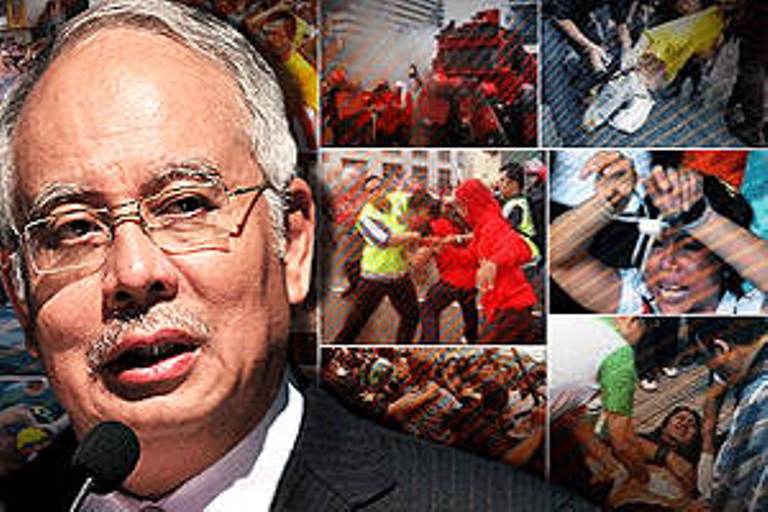
This article was first published in Economist on 14th July 2011. According to Pakatan Rakyat MP, KDN had tried to sensor the article by blacken all the points that shows police brutality. For the benefits of the readers to Bukittunggal.com, here today I republished the full article by the Economists.
As lesson learn to Malaysian Police, today is not like 20 years ago where police brutality will be captured and disseminate to all people all over the world. So to the police and the government..BEWARE every step you take...we will be watching You...The Police

MALAYSIA is one of South-East Asia’s stabler nations; but a rally in Kuala Lumpur on July 9th in demand of electoral reform turned surprisingly nasty, leading to the arrest of more than 1,600 people. The police fired tear gas and water cannon into the crowd, and one man died of a heart attack. All those arrested were released fairly quickly, but Amnesty International, a London-based human-rights group, called it “the worst campaign of repression in the country for years”. The government’s reaction showed a lot of nervousness about how much opposition it can tolerate.
In fact the crackdown started a few weeks ago after “Bersih 2.0” announced that it was going to stage the rally. Bersih, also known as The Coalition for Clean and Fair Elections, is a loose alliance of NGOs and activists (bersih means “clean”). It argues that all candidates should be given access to the mainstream media and that indelible ink should be used to stop people voting more than once. It all sounds uncontroversial, but not to the government. Bersih was declared illegal on July 1st and about 200 activists were rounded up. The march itself was then banned, although the authorities offered Bersih a stadium to meet in—and then withdrew the offer.Perhaps the government was looking back nervously to the first Bersih march, in 2007. On that occasion, too, thousands protested against the Barisan Nasional (BN) coalition government and demanded reform. Subsequently, in the 2008 general election, the BN lost its largest share of votes since 1957 when it started ruling the country after the British left. The current prime minister, Najib Razak, deputy prime minister in 2007 before taking over the top job in an internal party coup, must have feared that the second Bersih rally might be a similar portent. He has to hold an election before 2013, but wants to do so earlier to win his own mandate. Opposition politicians were quick to join Bersih. The pre-eminent leader of the opposition, Anwar Ibrahim, was shoved to the ground and injured in the affray.Mr Najib defended the police and accused the marchers of sowing chaos. Dismissing the motives of Bersih, he cast it as a desperate attempt by Mr Anwar to grab power. The immediate upshot is that Mr Najib may choose to delay calling for an election for some time, to let things settle down. He presumably hopes that if he waits long enough, people will have forgotten about this ugly incident. But the longer-term effects are hard to judge. It might also help to unite a fractious opposition against what they portray as an assault on democracy.

The beginning for Malaysian Politic: In 2007 BERSIH Rally Had denied BN of 2/3 Majority. The BERSIH 2.0 Rally Will Wipe Out BN Majority.
None of this bodes well for Malaysia. The heavy-handed police tactics have provoked a lot of anger; the government has conceded an official investigation into claims of police brutality. In one instance (caught on film), police seemed to fire tear gas and water cannon into a hospital where protesters were sheltering from a baton charge. Few old laws were left untouched in the attempt to round up suspects before the march. It was reported that 30 people arrested in Penang were investigated under Section 122 of the Penal Code for the charge of waging war against the king. Dragging in the constitutional monarch, Tuanku Mizan Zainal Abidin, seemed particularly desperate, reminiscent of the abuse of the monarchy’s position in neighbouring Thailand. On the eve of the rally, the king came out with a statement reminding everyone that “street demonstrations bring more bad than good, although the original intention is good.”


Mupok Aku


Sunday, July 17, 2011

Khalid Samad: Thanking Najib For Police brutality against peaceful rally

Kuching
Sunday, 17th July 2011

Khalid Thanking Najib for allowing the Police to use "mild" force against BERSIH 2.0 rally.

"Malaysians participated in BERSIH 2.0 rally recently should thanking and love Najib for did not ask the police to kill them" said the Shah Alam MP, Khalid Abdul Samad.

Cynically the Shah Alam MP Khalid , Khalid Abdul Samad wanted all Malaysians especially the victims of police brutality during the BERSIH 2.0 rally on 9 July 2011 to thanks the PM Datuk Seri Najib Razak.

Please see full report quoted in Harakahdaily below.

"Seharusnya rakyat berterima kasih dan sayang kepada Najib sebab dia tak bunuh peserta himpunan hari tu," kata ahli parlimen Shah Alam, Khalid Abdul Samad.

Secara sinis, ahli parlimen Shah Alam, Khalid Abdul Samad mahu rakyat khususnya mangsa keganasan polis semasa perhimpunan BERSIH 2.0 pada 9 Julai lalu berterima kasih kepada Perdana Menteri Datuk Seri Najib Razak.
Menurut Harakahdaily, Khalid membuat gesaan itu kerana Najib mendakwa pihak polis menggunakan tindakan agak "ringan" terhadap peserta perhimpunan itu.
"Seharusnya rakyat berterima kasih dan sayang kepada Najib sebab dia tak bunuh peserta himpunan hari tu," katanya dipetik akhbar rasmi PAS itu sambil ketawa terbahak-bahak.
Najib ketika ditemubual beberapa wartawan di London semalam dilaporkan berkata, pihak polis menggunakan tindakan yang sewajarnya dalam usaha menyuraikan peserta perhimpunan BERSIH 2.0 di ibu negara Sabtu lalu.
Katanya tindakan polis agak ringan kerana tahanan dibebaskan selepas lapan jam dan mereka dilayan dengan baik.
Kelakar
Beliau juga mendakwa tiada penggunaan tindakan yang tidak wajar oleh polis dan penunjuk perasaan disuraikan dengan menggunakan kekerasan yang minumum.
Sambil mendakwa kenyataan Najib itu sebagai kelakar, Khalid yang turut menerima enam jahitan di kepala akibat terkena kanister gas pemedih mata pada hari itu berkata perdana menteri langsung tidak menunjukkan rasa bersalah.

"Itulah minda autokrat perdana menteri kita. Kita tidak boleh salahkan dia.
"Saya yakin dia tak rasa dia menipu, dan tak rasa bersalah pun (mengeluarkan kenyataan sedemikian), walaupun seluruh dunia sudah melihat rakaman video dan gambar keganasan polis dalam internet," katanya yang juga AJK PAS Pusat.
Pada perhimpunan yang dihadiri ribuan rakyat daripada pelbagai lapisan, sejumlah 1,667 orang ditahan oleh pihak polis. Mereka kemudiannya dibebaskan selepas diambil keterangan pada hari yang sama.

Bagaimanapun selepas itu, ramai yang tampil mendakwa pihak berkuasa bersikap ganas terhadap mereka yang datang secara aman.
Suruhanjaya Hak Asasi Manusia (Suhakam) juga dihujani pelbagai aduan peserta mendakwa polis menendang dan memukul mereka sebelum ditangkap.
Suhakam yang juga menghantar pasukan pemantau pada hari itu juga mengakui, polis menggunakan kekerasan sewaktu menyuraikan peserta himpunan.
Beberapa bukti kekasan dan keganasan polis itu juga kini tersebar di internet khususnya di Youtube

Mupok Aku

SUARAM Is Going to Reveal That Third commission Was paid for Scorpene subs

Kuching
Sunday, 17th July 2011

In Malaysia, the Judicial system if influence or control by executive. But we hope the international organization can brings whosoever responsible with siphoning government money (considering that Malaysians are still poor) to international court...


It says new evidence points to the issuing of a third commission, which is even ‘bigger' than the earlier ones.
Come next Thursday, Malaysians would get to hear first-hand from a French lawyer that even "bigger" commissions were paid to "extremely high level" government officials in Malaysia related to the purchase of two submarines in 2002.

Penangites would be ahead of those in Kuala Lumpur and Ipoh to hear lawyer William Bourdon spills the beans on the controversial deal with French company DCNS in a fundraising event dubbed 'Ops Scorpene'.


KL-based human rights NGO Suaram is organising a dinner in Bayan Baru where besides Bourdon, its board member Cynthia Gabriel, DAP national adviser Lim Kit Siang, PKR vice-president Tian Chua and PAS deputy president Mohammed Sabu will speak.

 According to Gabriel new evidence points to the issuing of a third commission which is "bigger" than the earlier ones paid out to a Malaysian consulting company calledPerimekar Sdn Bhd."The details would be revealed at the lawyer's exclusive presentation in the dinner events," said Gabriel at a press conference in Penang yesterday.


"I cannot reveal much but would encourage everyone to attend the event," she added. "We are shocked that there are many more commissions being paid out to unidentified government officials in the country... and these are top officials," she lamented. 

Perimekar is a subsidiary of KS Ombak Laut Sdn Bhd, and the major shareholder in this obscure company is allegedly political analyst Abdul Razak Baginda's wife, Maslinda Makhzan. Abdul Razak is the close ssociate of Prime Minister Najib Abdul Razak, who was defence minister when the multi-billion ringgit submarine deal was negotiated. He was charged in 2006 with abetting two police officers, who were Najib's bodyguards, in the gruesome murder of Mongolian national and translator Altantuya Shaariibuu, believed to be his mistress. 


Abdul Razak, head of a pro-government think-tank, was acquitted in 2007 without his defence being called. The two police officers have since been convicted of murder and are now on death row.Altantuya-Abdul Razak's trip to HK On Monday, Suaram disclosed travelling details of Abdul Razak and Altantuya to Hong Kong, after it revealed a trip to Macau with another "mystery" individual related to negotiations over the deal. Last year, Suaram through its lawyers in France - Bourdon and his team - filed a case with prosecutors in Paris over claims that French defence giant DCNS paid RM540 million in commission to Perimekar. Payment of commissions is illegal under French laws. 

The French probe revealed another 30 million euros (RM150 million) were paid to DCN's commercial network Thales and another 2.5 million euros (RM7.5 million) paid to an "unknown" recipient. The Malaysian Defence Ministry has however denied that commissions were paid for the two submarines. In a written parliamentary reply, Defence Minister Ahmad Zahid Hamidi said that the government had only made payments to two contractors - France's DCNS and Spain's Navantia - for the construction of the submarines. Perimekar on the other hand, was paid for "coordination services" for the Malaysian submarine crew, added Ahmad Zahid, who said he wasready to testify in court on the matter.Funds needed for legal costs 

Meanwhile, Cynthia said that Suaram was organising the dinner in the three cities to raise public awareness of how taxpayers funds are being spent on arms procurement in the country. "Everyone has the right to know the truth and seek answers about where our money goes when it comes to these arms deals," she told reporters in George Town. "This is a campaign by Malaysians, not Suaram alone, to promote transparency in arms procurement," she added. "We are fundraising because when the case goes to open court - perhaps sometime in August, we need to pay for legal costs," she stressed. Bourden's team works at Sherpa, a non-profit organisation that advocates corporate social responsibility, and it has been providing pro bono services for Suaram thus far. Suaram hopes to raise about RM100,000 to cover the legal costs. Other than selling seats for the three dinner events, the NGO is also seeking donations.


Mupok Aku

Friday, July 15, 2011

OBAMA Is With BERSIH 2.0

Kuching
Friday, 15th July 2011

US Support for BERSIH 2.0 Early warning for BN that they are going to BE END

In Great Britian Queen Elizabeth was seen wearing yellow dress and Najib bowed toward her. In US, President Barrack Obama was shown holding BERSIH 2.0 T-Shirt. In Malaysia, BN Beware as the Wrath  against Libyan Dictator may soon reach Malaysia!

Mupok Aku

Blog Widget by LinkWithin

BlogTopsites

Politics Blogs - Blog Top Sites

Alexia Rank

Technorati

BlogSearch Engine

BlogRanking

Politics Blogs - Blog Rankings